Monday, November 21, 2022

7 Steps to Creating Presence in Online Courses - Assessing for Presence and Community

Online teaching and learning should be an experience where presence is felt by both instructors and learners - Assessing for Presence and Community.

During the past weeks we've walked through the 7 Steps and Four Phases for developing online courses with Presence and Community. But - how do you know that presence and community are there once your course is finished? Well, you’ll certainly feel and know it qualitatively, but you need more than that - you need tools and methods for assessing quantitatively. We share a Chart of Tools and Methods our instructor used to help with this assessment. 

Next and Final Week - Bringing it All Together and a Wordle.


Reference

Lehman, R. M., & Conceição, S. C. (2010). Creating a Sense of Presence in Online Teaching: How to “Be There” for Distance Learners. Jossey-Bass. 


Monday, November 14, 2022

7 Steps to Creating Presence in Online Courses - Step 7, Phases Three and Four


Online teaching and learning should be an experience where presence is felt by both instructors and learners. How is presence created?

Step 7, Phases Three and Four. During the past weeks, you’ve been introduced to the 7 Steps to Creating Presence in Online Courses and the first and second of the Four Planning Phases that will help you develop the course learning experience. This week we’ll look at phases three and four – “end of course and after course.” The Incorporation Chart for these phases illustrates how our instructor used the presence Model and Framework for the: Course Sequence, Course Activities, Types of Experience, and Modes of Presence.
 

Reference

Lehman, R. M., & Conceição, S. C. (2010). Creating a Sense of Presence in Online Teaching: How to “Be There” for Distance Learners. Jossey-Bass. 


Monday, November 7, 2022

7 Steps to Creating Presence in Online Courses - Step 7, Phase Two


Online teaching and learning should be an experience where presence is felt by both instructors and learners. How is presence created?

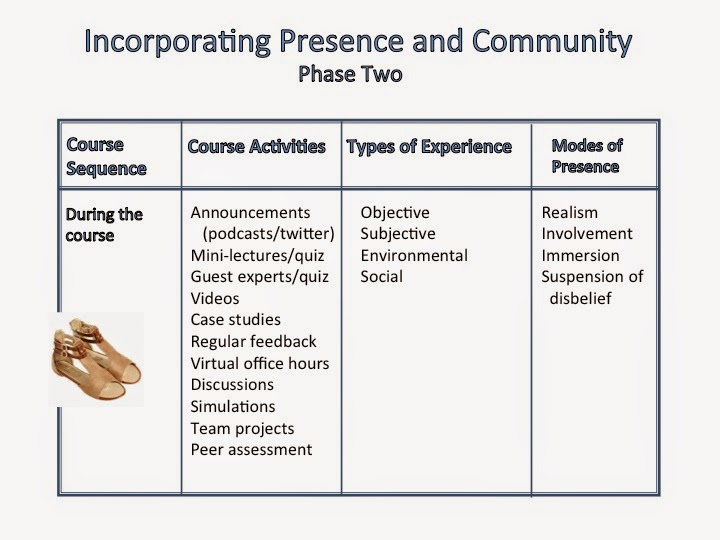
Step 7, Phase Two. During the past weeks, you’ve been introduced to the 7 Steps to Creating Presence in Online Courses and the first of the Four Planning Phases that will help you develop the course learning experience. Last week we looked at phase one – “before the course begins.” This week we’ll look at phase two – “during the course.” The Incorporation Chart for this phase, below, illustrates how our instructor used the presence Model and Framework for the: Course Sequence, Course Activities, Types of Experience, and Modes of Presence.

It’s helpful while you’re looking at the Chart to refer back to the Framework (which includes the Model) in Step 6.


Reference


Lehman, R. M., & Conceição, S. C. (2010). Creating a Sense of Presence in Online Teaching: How to “Be There” for Distance Learners. Jossey-Bass. 
Monday, October 31, 2022

7 Steps to Creating Presence in Online Courses - Step 7, Phase One


Online teaching and learning should be an experience where presence is felt by both instructors and learners. How is presence created?

During the past weeks, you’ve been introduced to the 7 Steps to Creating Presence in Online Courses. Step 7 was Creating the Plan. The important thing to remember here is that you are creating a “learning experience.” So your designing isn’t just for “during the course” but includes before, during, at the end of the course, and even after. The Charts during the next weeks will show you how our instructor incorporated everything in these four phases. 


Her Incorporation Chart for “before” the course begins is shown in the graphic. It illustrates how she planned the Course Sequence, Course Activities, Types of Experience and Modes of Presence. It’s helpful while you’re looking at this to refer back to the Framework (which includes the Model) in Step 6.

Reference


Lehman, R. M., & Conceição, S. C. (2010). Creating a Sense of Presence in Online Teaching: How to “Be There” for Distance Learners. Jossey-Bass. 


Monday, October 24, 2022

7 Steps to Creating Presence in Online Courses - Step 7

Online teaching and learning should be "an experience" where presence is felt by both instructors and learners. How is presence created?  

The seventh step for creating online presence is to use the Framework described in Step 6 to create a Design Plan. Remember, the Framework includes the Learner-Centered Model and the Determinants of Presence. Let's look at an example of how the plan was developed by a science instructor. In her course: 

  1. the Content she created was both content- and process-based.  
  2. the Format included a blend of individual and group work (more individual in the beginning, transitioning to group work after the first few weeks). 
  3. the Interaction Activities she selected supported the Content and fit her students’ needs.
  4. the Roles she played as instructor were determined by the level of institutional Support she had, the course Content, and the Format she had created (as a result, she played a number of Roles).
  5. the Technologies she chose were to implement the Format and enable the Interaction Activities. 
  6. the Support she used included three types: instructional, technical, and self-support. Self-support is an important new addition to this determinant and focuses on setting self-boundaries and taking care of self. This is important not only for the instructor but also for the learners.

The science instructor's Design Plan illustrates this seventh step.

But Step 7 is an expansive step. In online learning you are creating a “learning experience” …so you’re designing in phases; not just when the course happens (during) but also before the course begins, at the end of the course, and even after. In the next weeks you’ll see how our instructor expanded the Design Plan to develop these phases. 


Reference 

Lehman, R. M., & Conceição, S. C. (2010). Creating a Sense of Presence in Online Teaching: How to “Be There” for Distance Learners. Jossey-Bass.